What caught our clinicians’ attention at this year’s Australasian Menopause Society Congress? From simple ways to build more movement into your day to spotting menopause misinformation, here are some of their favourite learnings from this year’s Congress.
The annual Australasian Menopause Society Congress is always a highlight of our clinical calendar – a chance to hear the latest research, learn from experts across a wide range of disciplines, and bring new knowledge and ideas back into the care we provide every day.
This year, a number of our WellFemme clinicians gathered in Sydney for the 2026 Congress. Afterwards, we asked them a simple question:
What was one of your favourite or most useful take-home messages?
Their answers covered everything from exercise, heart and bone health to mood, sexual wellbeing and the increasingly tricky business of sorting good medical evidence from convincing misinformation.
Here are some of the things that stayed with them:
Every minute of movement counts – but not equally
For Dr Alice Webb, one of the standout sessions was about exercise and the surprising benefit we can gain from adding short bursts of intensity to our day.
“Move more in any way you can, but add intensity as much as possible.”
One of her favourite practical ideas was “snacking” on exercise:
“‘Snacking’ on exercise is an excellent way to get exercise into your day, doing a minute of movements such as squats, push ups or rapid stepping.”
Alice also noted the striking comparison presented at Congress: one minute of intense exercise was equivalent to 4–9 minutes of moderate exercise or 52–156 minutes of light activity.
Dr Melissa Cave came away enthusiastic about the same idea:
“I loved the exercise snacking!”
She also highlighted the fact that women are now working through menopause in greater numbers than ever before, and found the discussion about how we can better help women navigate this stage of life particularly interesting.
WellFemme note: “Exercise snacking” simply means breaking physical activity into very short bouts across the day, rather than assuming exercise only counts if it happens in a longer formal workout.
Perimenopause is an important time to pay attention to metabolic health
Nurse Julie Dutton was particularly interested in information presented about ages at which metabolic markers may worsen.
One of her take-home messages was that there appear to be two particularly vulnerable periods — firstly during perimenopause, in the 40s, and again at around age 60.
Julie also highlighted a useful resource for women experiencing vulval and vaginal concerns: the patient resources available through the Australian and New Zealand Vulvovaginal Society.
PMDD, mood and the order in which hormones are introduced
For Dr Sonia Van Gessel, a presentation on Premenstrual Dysphoric Disorder (PMDD) was particularly memorable.
“I really enjoyed the PMDD talk. Big learning from this – don’t be afraid to introduce estrogen on its own initially to provide the benefit to mood before adding in progestins.”
WellFemme note: PMDD is a severe cyclical mood disorder associated with sensitivity to normal hormonal fluctuations. Treatment needs to be individualised, particularly when considering hormonal therapy.
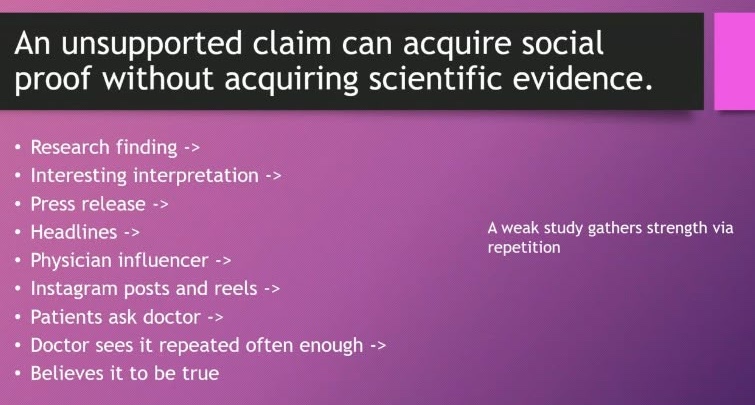
Hearing something repeatedly doesn’t make it true
For WellFemme Founder Dr Kelly Teagle, one of the most thought-provoking presentations was “Using and misusing evidence – how do we spot menopausal misinformation?”
The session explored how social media algorithms can shape the health information we see and, importantly, how repetition can make a claim begin to feel more credible – even when the evidence behind it is weak.
As Kelly reflected:
“If all the posts put in front of us (many that we did not actually choose to view) are relating the same messages, then by repetition our brain accepts them as being true… whether they are or not!”
Her other key takeaway was equally important:
“Just because you hear something multiple times — or even from multiple sources — it’s not necessarily true.”
Dr Linda Burnett took away a very similar message:
“It was an important reminder that not everything we read is true, even if it is being discussed constantly on social media.”
For anyone consuming health information online, it is a useful reminder to keep asking: Where did this claim come from? What evidence supports it? And are we seeing it repeatedly because it is well established, or simply because an algorithm has learnt that we are interested in it?
A different way to think about libido
A session on libido and intimacy particularly resonated with Dr Elise Turner.
Her takeaways included some thought-provoking ways of reframing conversations about sexual desire:
“Can still have a healthy libido and still not want sex.”
and:
“‘I don’t desire sex’ vs ‘I don’t desire THIS sex’.”
She also highlighted the relationship between desire and the demands being placed on us:
“Our capacity for desire [is] inversely proportional to nervous system load.”
And perhaps most importantly:
“There is societal expectation to lose desire around menopause/ageing – let’s reverse this!”
WellFemme note: Sexual wellbeing is complex, and conversations about libido may need to consider stress, relationships, life circumstances and many other factors – not simply hormones.
Midlife is a window for looking after both heart and bone
Dr Cecilia Akinloye came home with two clear preventative-health messages.
Her first was:
“Women aged 45 and over: it’s time for a heart health check.”
She suggests talking with your GP about cardiovascular risk factors including blood pressure, waist measurement and blood sugar levels such as HbA1c:
“Early checks can help protect your long-term heart health.”
Her second message concerned bone health:
“Menopause is a key window: The 2–3 years before and after the final menstrual period see the fastest bone loss. This is a good time to assess your risk(s), discuss lifestyle, and consider treatment if indicated.”
Bone health was a recurring theme
Bone health featured strongly across several presentations and was a standout topic for a number of our clinicians.
Dr Katherine Turner also particularly enjoyed Amanda Beach’s presentation on bone health. For Kath, an important message was that looking after our bones needs to begin well before menopause:
“One of the key messages I thought was how important it is to optimise our bone density in our younger years, and how the peak bone loss is in the year before your final menstrual period up until two years after that final menstrual period.”
Bone health was also prominent among Dr Celine Goh’s favourite learning points.
One statistic that caught her attention was:
“Lifetime risk of minimal trauma fracture for women >60: 44%.”
She also highlighted the discussion around menopausal hormone therapy (MHT) and bone:
“Even lower doses of Estrogen hormone therapy have good effects for bones, no need to go to high doses just for bones.”
Another important practical message was:
“If MHT is stopped, BMD plummets steeply. So need to transition to other therapies for bone.”
And Celine’s final point brought the discussion back to movement:
“All movement matters: minimise sedentary time, progress from short bouts to regular resistance and aerobic training.”
WellFemme note: BMD means bone mineral density. Decisions about MHT or other osteoporosis treatments depend on an individual woman’s age, medical history, fracture risk and other factors, and should be discussed with her treating clinician.
What did we bring home from Sydney?
Looking through everyone’s notes, it was striking how often the themes overlapped.
Move more. Protect your heart and bones. Pay attention to health changes through midlife. Think broadly about mood and sexual wellbeing. And perhaps more than ever, be thoughtful about where your health information comes from.
Congresses like this are an opportunity for our clinicians to update their knowledge, challenge their assumptions and bring fresh ideas back to their consultations.
They are also a reminder that menopause medicine extends well beyond hot flushes and hormone prescriptions. It is about helping women stay healthy and well through midlife and beyond.
And yes — apparently even one minute of squats counts.
A note from WellFemme: The information above reflects selected learning points our clinicians brought home from presentations at the 2026 Australasian Menopause Society Congress. It is general educational information rather than individual medical advice. Treatment decisions — including the use, dose or timing of menopausal hormone therapy – should always take into account your individual circumstances and be discussed with an appropriately qualified healthcare professional.
Created with the assistance of AI.
Banner image credit: Dr Jen Gunter https://drjengunter.wordpress.com/